The practice
Facts for planning — adapt them to your group.- Players
- GK + 4 v 3 + 1 target
- Area
- 37 × 27 m
- Time
- 3 × 6 min
- Space
- 125 m² each
Equipment: 2 cone gates, a target zone, balls in the goal, 2 bib colours
Few things make grassroots coaches more nervous than a goal kick. Ask your keeper to play short and you risk giving away a goal. Let them kick it long every time and your defenders never learn to play. The answer isn't "always short" or "always long". Teach players to read the press and pick the right option, then give them a practice where they can make mistakes safely.
This is a three-step progression for 7v7 and 9v9 teams (about U10–U13 in England from the 2026/27 season; check your own league's format). Each step adds one opponent or one decision, so players are never thrown in at the deep end.
What "playing out from the back" really means
Playing out from the back means starting attacks with the goalkeeper and defenders passing through the first line of pressure, rather than clearing it. Done well, it:
- keeps the ball for your team instead of giving it back with a hopeful kick
- pulls opponents forward and opens space behind them
- gives defenders and the keeper hundreds of touches under realistic pressure
Done badly, it's a passing drill that ignores the opponent. The aim is decision-making: play through when it's on, go round or over when it isn't. Even England's youth teams don't restrict build-up to short passes. It's about choosing well.
A note for leagues with younger formats: some competitions use a retreat line on goal kicks, where the opposition has to drop back to a set line before the ball is played. If yours does, use it. It's there to give players time to try this.
Before you start: shape and the "big pitch" rule
The most common problem at this age is bunching. When the keeper has the ball, everyone runs towards it. Give players one simple rule:
"When we have the ball, make the pitch big."
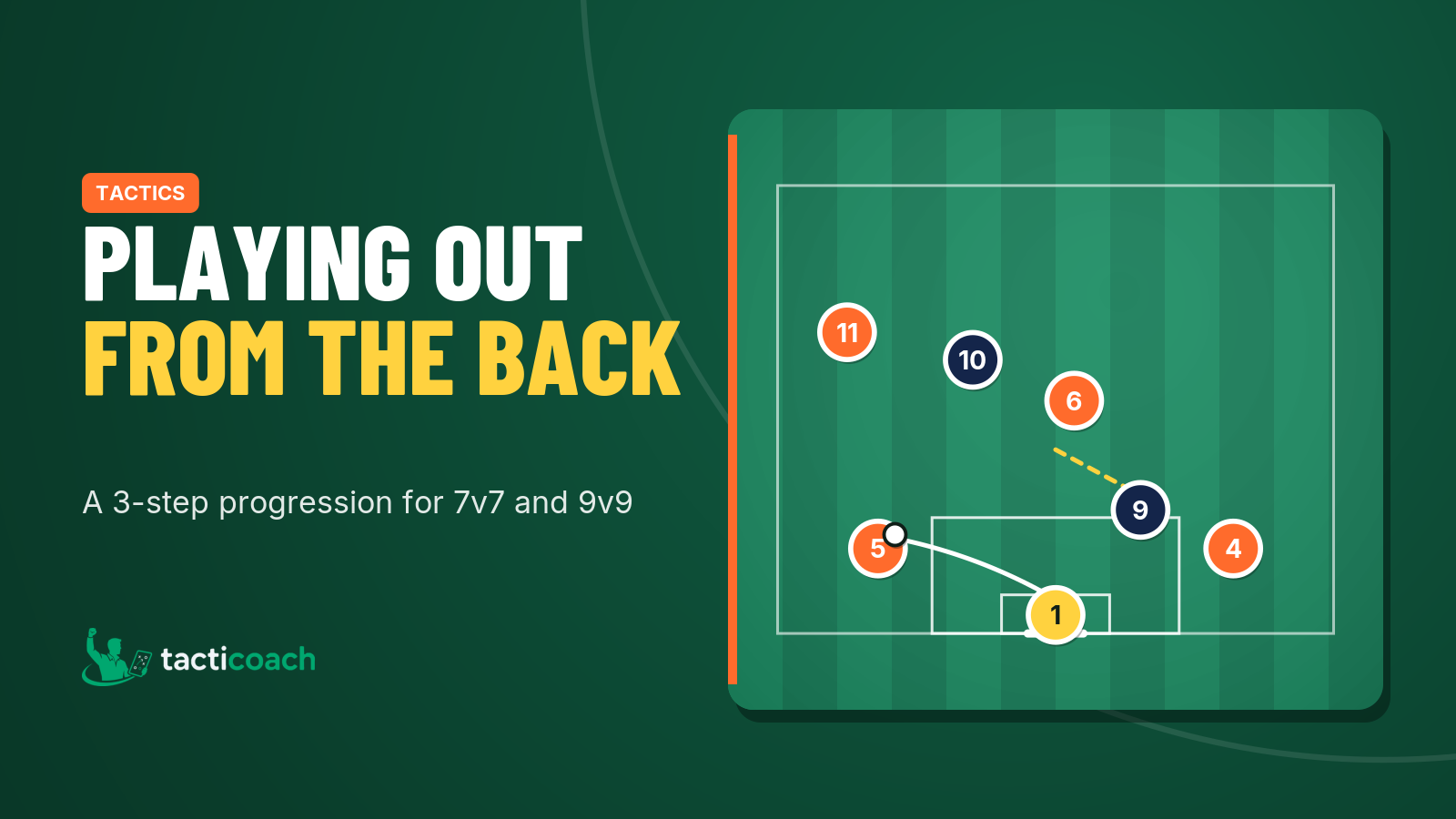
- The two defenders split wide, about level with the edges of the penalty area.
- One midfielder drops in front of them to give a central option.
- Wide players stay high and wide to stretch the opposition.
If two players are standing next to each other, one of them is in the wrong place.
Step 1 — 3v1: keeper and two defenders against one striker
- Area: from the goal line to about 20 m out, the width of the penalty area plus a few metres.
- Players: GK + 2 defenders against 1 striker. Run two groups if you have two keepers.
- Goal: the defenders score by dribbling over the end line (or through one of two cone gates) after at least one pass.
- The striker scores by winning the ball and shooting.
Coaching focus: the defenders open up wide and half-turned, so they can receive and face forward. The keeper's first touch goes away from the striker, and they play to the defender the striker isn't covering.
Step 2 — 4v2: add a midfielder and a second presser
- Area: extend to about 30 m out.
- Players: GK + 2 defenders + 1 midfielder against 2 strikers.
- Goal: score by passing into a target player or a gate at the far end.
Now the strikers can block one pass and press another, so players have to find the free player. Coach the midfielder to move into the gap between the two pressers, and the defenders to switch the ball through the keeper when one side is blocked. The goalkeeper is an extra outfield player in this practice. Encourage them to stay available.
Step 3 — the real decision: GK + 4 v 3, with the long option
- Area: half a pitch. On a 7v7 pitch that's roughly 37 × 27 m.
- Players: GK + 4 (two defenders, two midfielders) against 3 pressers, plus 1 target player beyond halfway. That's 9 in total, and spare players can rotate in as pressers every few minutes.
- Goal: score by passing into one of two end gates (short), or by playing a ball over the top into a target zone beyond the halfway line, where a target player can control it (long).
This is where the learning happens. If the pressers come high and leave space behind, the long option is the right answer, and players should be praised for choosing it. If the pressers sit off, play through them. Freeze the play once or twice to ask: "Where's the space: in front of them, between them, or behind them?"
Coaching points
- Get the shape first. Wide defenders, a central option, and the pitch made big before the keeper plays.
- Receive to face forward. Open your body so your first touch takes you towards their goal, not your own.
- Find the free player. If a pass is blocked, the ball goes round the press, through the keeper if needed.
- Short, round or over. Look at the press and choose. A good long pass is not a failure.
When it goes wrong (it will)
Your team will give away a goal doing this. That's normal. Players need permission to make mistakes while they learn. A few things help:
- Celebrate good decisions, not just successful passes. A well-judged long ball deserves praise too.
- Don't shout "clear it" in the game if you've asked for this in training. Mixed messages confuse players faster than mistakes do.
- Keep the progression in step with the group. If Step 2 is breaking down, go back to Step 1 for a week. It isn't a step backwards.
Show the picture
Playing out is a shape problem as much as a technique one, and players get it faster when they can see the shape. Draw the keeper, the two wide defenders, the dropping midfielder and the pressers on a board, then animate one sequence: the keeper plays to a defender, the striker presses, and the ball goes to the free player. Players can watch it on a phone before the session.
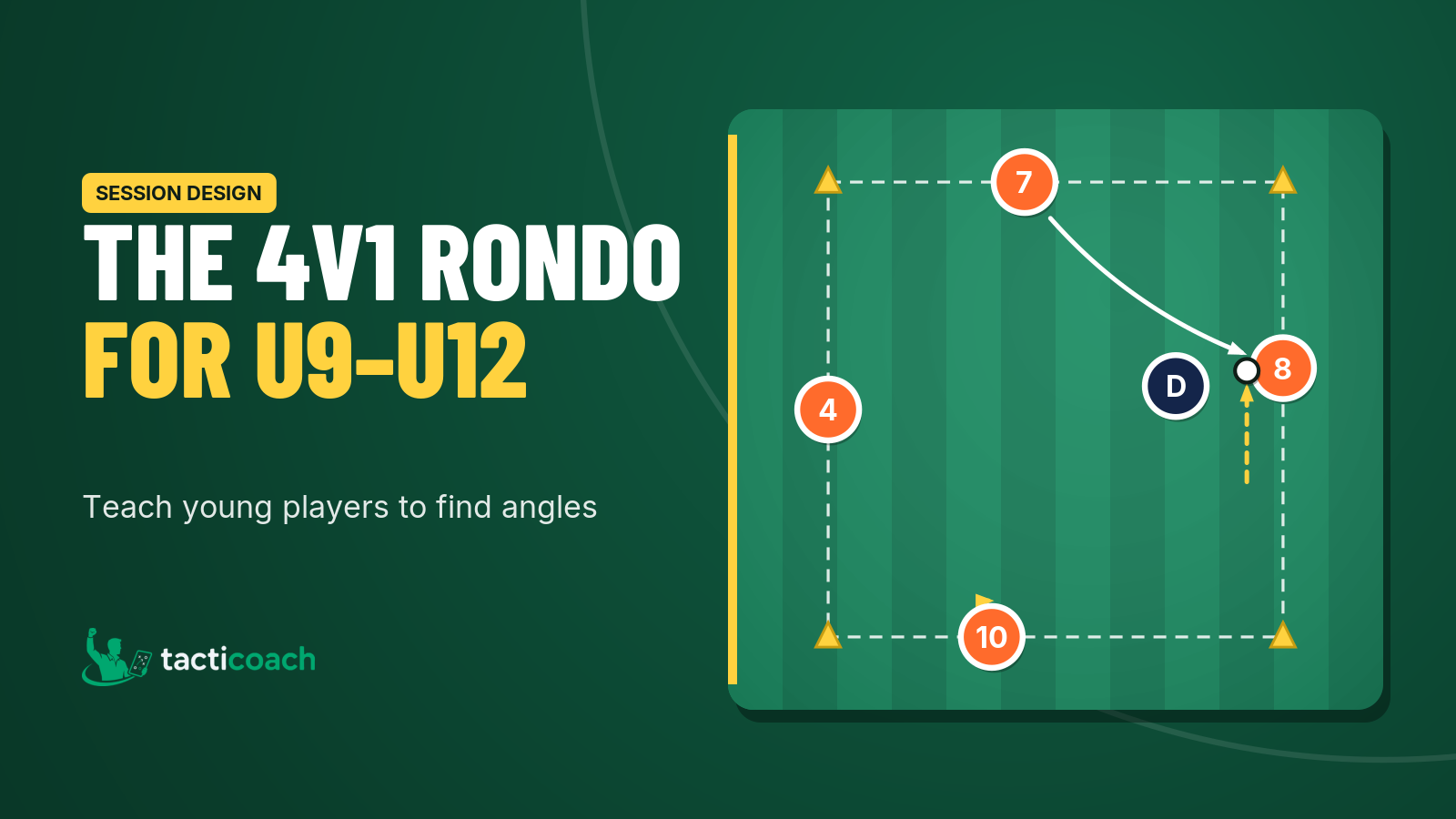
Pair this with our 4v1 rondo for U9–U12: the angles players learn in the rondo are exactly the ones they need here.
Put this into practice tonight
The board, the drill sheet and a 4K video for the parents' group — all from one practice. Opening to coaches soon.