You spend five minutes at half-time explaining how to press. Everyone nods. Two minutes into the second half, your striker is chasing the ball on their own and the rest of the team is watching.
It isn't that young players don't care. It's that most tactical explanations are built for adults: too many words, too many ideas, and nothing to look at. This guide shows you how to explain tactics to youth players in a way that sticks, using one idea, one picture and a practice that does the teaching for you.
Why young players forget the team talk
Three things work against you every time you explain a tactic with words alone.
- Too much at once. "Stay compact, press the full-back, don't dive in and look for the switch" is four instructions. Most players will keep one, and it may not be the one you wanted.
- Words without a picture. "Shift across" means something to you because you can see the shape in your head. A 10-year-old can't see your head.
- No link to a real moment. A tactic only makes sense when players recognise the moment it belongs to: the back pass, the loose touch, the throw-in on their side.
England Football's own guidance makes a similar point: give players one relevant instruction to remember, or a challenge to achieve, rather than a long list (England Football Learning).
How to explain tactics to youth players: 6 steps
1. Pick one idea per session
Before training, finish this sentence: "Tonight, I want them to know what to do when…". If you can't finish it in one line, the idea is too big.
Good single ideas for grassroots teams:
- When the keeper has the ball, our full-backs go wide.
- When they pass back, the nearest player presses and everyone else moves up.
- When we lose the ball, the closest player tries to win it back straight away.
One idea per session feels slow. It isn't. Three sessions with one clear idea each beat one session with three ideas that nobody remembers. If you need a structure for the rest of the session, see how to plan a football training session.
2. Give the tactic a name they'll say back to you
Players remember names, not descriptions. "The trap", "the door", "make it big" or "five-second hunt" are easier to shout on a Saturday than "compress the space after a turnover".
Let the players help choose the name. If they invented it, they'll use it.
3. Show the picture before you talk
Put the moment on a board first, then explain it in about 30 seconds. Show:
- Where everyone starts. Just the players involved, not all 11.
- The trigger. The ball, the pass or the touch that starts it.
- One run or one pass. The movement you want, drawn as a single arrow.
Keep it to the players who matter. If your board has 22 dots and six arrows, it's an adult's board. For younger groups, three or four players and one arrow is plenty.
A moving picture helps even more, because players see when to move, not just where. Animating the board, even with two frames (the start positions, then the run), shows timing in a way a still drawing can't.
4. Let the practice ask the question
The best explanation is a practice where the tactic is the obvious answer. Instead of telling players to press after a back pass, set up a game where back passes happen often and pressing them wins points.
A few simple constraints that do the explaining for you:
- "Win it back in five seconds" and score a bonus goal.
- A wide channel only full-backs can enter, so the team has to make the pitch big.
- The goal only counts if the ball went through the middle zone first, to reward playing through the lines.
Small-sided games are ideal for this, because every player gets more moments to recognise the trigger (small-sided games explained).
Then step back. The practice will show you who understood and who needs another look at the picture.
5. Ask, don't tell
When you stop play, freeze the players where they are and ask one question:
- "Where's the space?"
- "Who should go now?"
- "What happened just before we lost it?"
A player who answers the question themselves remembers it far better than one who was told. Keep stoppages short; 30 seconds, then play again.
6. Send the picture home
Most of what players learn happens after they leave the pitch. A short clip or a single picture of the idea, shared after training, gives them a second look when their heads are clear.
Make it about the team idea, not about individual mistakes, and send it through the same safe, private route you already use with players and parents. One idea, one picture, one line of text: "This week: the trap. Watch the left-back."
How much tactics for each age group?
There's no single right answer, and every club and country works differently. As a rough guide for how much to explain, not what format to play:
| Age group | How much to explain | What works best |
|---|---|---|
| U7 and under | Almost nothing in words | Games that reward the behaviour; one word to shout |
| U8–U9 | One simple idea, said in a sentence | A picture with two or three players; lots of repetition |
| U10–U11 | One idea per session, with a name | Board before the practice; questions during it |
| U12–U13 | One main idea plus a small detail | Moving pictures that show timing; players explaining back |
| U14–U15 | Linked ideas across a few weeks | Short clips; players spotting the trigger themselves |
| U16–U18 | Team principles and roles | Players leading parts of the explanation |
The rule for every age is the same: if they can't say it back to you in one sentence, it was too much.
Example: a 10-minute plan for "the trap"
Here's how the six steps fit into one part of a session for, say, an U12–U13 group.
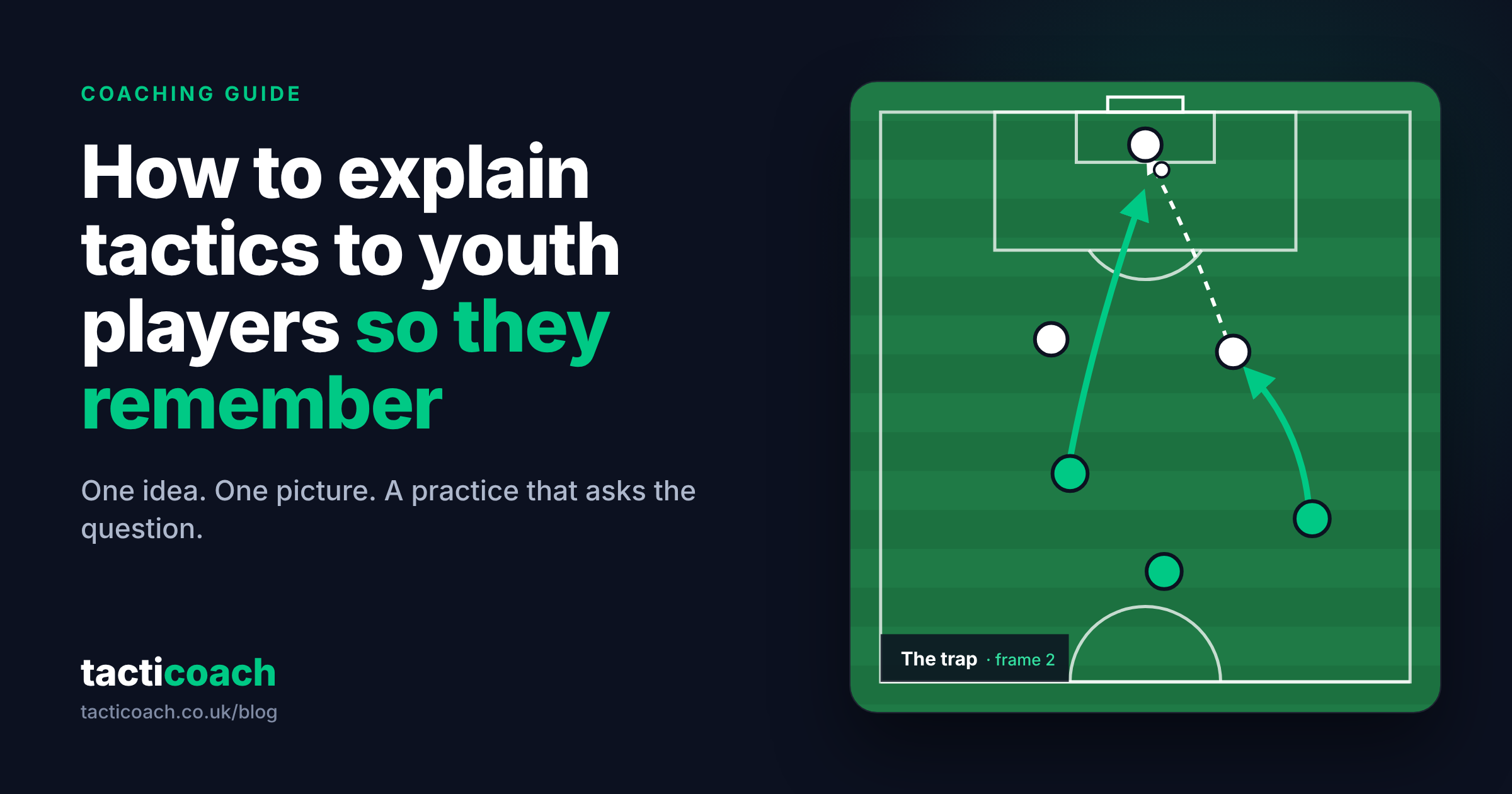
- Two minutes, the picture. Show the board: the opposition centre-back, the back pass to the keeper, our striker curving the run to block the return pass, and our winger stepping up. Say the name: "That's the trap."
- Six minutes, the practice. A small game where the defending team scores a bonus point for winning the ball within five seconds of a back pass.
- One stop, one question. Freeze play after a good or bad example: "Who should go now?"
- Two minutes, the reminder. Show the picture one more time before the next game, and send it home afterwards.
That's it. No long talk, and the players have seen it, done it and said it back.
Common mistakes to avoid
- Explaining the whole system. Players don't need the formation; they need to know what to do in one moment.
- Long stoppages. If the explanation takes longer than the activity, players switch off.
- Changing the idea every week. Repeat the same idea in different practices for two or three weeks before moving on.
- Correcting individuals in front of everyone. Use the team picture to explain; give individual feedback privately and positively.
- Drawing everything. The more arrows on the board, the less anyone remembers.
FAQ
At what age should you start teaching tactics to youth players?
You can introduce simple tactical ideas from a young age, but mostly through games rather than explanation. With the youngest groups, design games that reward the behaviour you want and use a single word as a cue. Add short explanations as players get older and can say the idea back to you.
How long should a tactical explanation be?
Around 30 seconds to two minutes for most youth groups. If you need longer, the idea is probably too big; split it into smaller ideas over several sessions.
Are tactics boards useful for kids?
Yes, if you keep them simple. Show only the players involved, one trigger and one movement. A board that moves through the start positions and then the run helps players see the timing as well as the position.
How do I check if players understood?
Ask them to explain it back in one sentence, or ask a question when you freeze play. The real test is whether the behaviour appears in the practice without you shouting it.
Should I share tactical videos with players?
A short, positive clip of the team idea can help, especially with older groups. Keep it about the team rather than individual mistakes, and share it through the private channels your club already uses with players and parents.
Make the picture the explanation
Young players don't remember the speech. They remember the picture, the name and the moment they got it right in a game. Pick one idea, show it before you say it, let the practice ask the question, and send the picture home.
If you'd like to build those pictures faster, TactiCoach lets you set up players on a board, add the run or pass, play it back as an animation, export it as a video, and turn it into a drill sheet for your players. Request early access and try it with your next session.
Put this into practice tonight
The board, the drill sheet and a 4K video for the parents' group — all from one practice. Opening to coaches soon.