The practice
Facts for planning — adapt them to your group.- Players
- 4 v 4
- Area
- 25 × 20 m
- Time
- 4 × 4 min
- Space
- 63 m² each
Equipment: 4 small goals, bibs, 3 balls
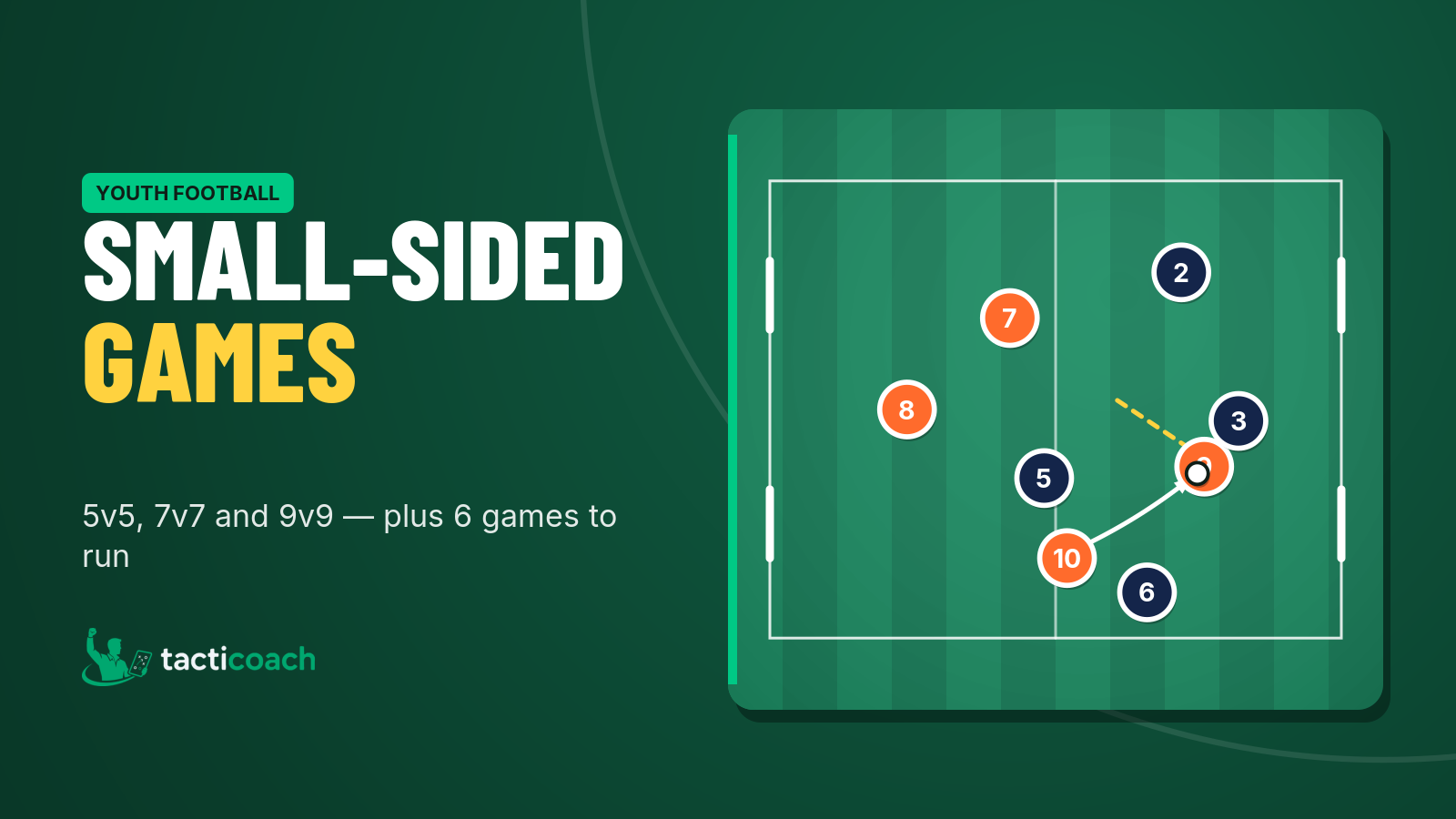
If you want your players to get better at football, let them play more football, in games small enough that everyone is involved. That's the whole idea behind small-sided games, and it's why youth football across the world is played in 5v5, 7v7 and 9v9 rather than 11v11.
This guide explains what small-sided games give young players, which format is used at which age (it varies by country), and six games you can run at training this week.
Why small-sided games work
On a full pitch with 22 players, a child can go minutes without touching the ball. Shrink the game and three things happen:
- More touches. Fewer players share one ball, so each player gets it more often. A study by García and colleagues (2014) found more ball contacts per player in 5v5 than in 7v7 and 9v9.
- More decisions. Every touch comes with pressure and a choice: pass, dribble, shoot or protect it.
- More of everything that matters: more 1v1s, more shots, more goals, and more defending, because nobody can hide.
A 2025 review of the research found the same pattern: smaller formats tend to improve technical skills, while bigger formats ask more of players' running. Both have a place in a session. The research also says to be careful with the detail, because results depend on pitch size, rules and the players.
Which format at which age?
This is the part that catches coaches out. There is no universal answer. Formats depend on your country, your league and sometimes the competition. Some examples:
- England (the FA, from the 2026/27 season): 3v3 at U7, 5v5 at U8–U9, 7v7 at U10–U11, 9v9 at U12–U13, 11v11 from U14. These are maximum formats: playing smaller is allowed. Each step moved a year later than before, so older resources may still show the previous ages.
- USA: roughly 4v4 up to U8, 7v7 at U9–U10, 9v9 at U11–U12 and 11v11 from U13. Check your state association.
- Germany (DFB): small-sided festivals with mini goals at the youngest ages, then 5v5 or 7v7 through U10–U11.
- Netherlands (KNVB): 6v6 for the younger age groups and 8v8 before 11v11.
Pitch and goal sizes vary too. In England, a 5v5 pitch is about 37 × 27 m and a 7v7 pitch about 55 × 37 m, but leagues and county FAs set the local detail. Check with your league before you mark out a pitch.
Six small-sided games to run this week
Each one works with 8–12 players. Run two pitches side by side if you have more. Play 4 × 4-minute rounds with a minute's break, and rotate players if numbers are odd.
1. Four-goal game (4v4)
A 25 × 20 m area with two small goals at each end. Teams can score in either goal at the end they attack. Players learn to switch the play when one goal is blocked.
2. End-zone game (4v4 or 5v5)
Replace goals with a 3 m end zone. You score by dribbling or passing into the zone and stopping the ball there. It's great for teaching players to run with the ball and to time a run.
3. 4v4 + 2 floaters
Two floaters (in a different colour) always play for the team with the ball, so the team in possession has a 6v4. It's perfect after a rondo session, because players get to use the angles in a game. Swap the floaters every round.
4. Gates game (3v3 or 4v4)
Scatter 5–6 cone gates around the area. A team scores a point by dribbling or passing through any gate to a team-mate. There's no goalkeeper and no waiting, and it's brilliant for younger groups.
5. Transition game (5v5 + goalkeepers)
Normal game, one rule: when you win the ball, you have 6 seconds to shoot. It teaches players to look forward the moment they win it back, and to react straight away when they lose it.
6. Match-format game
Finish with your real match format (5v5, 7v7 or 9v9) on a pitch the right size, with as few stoppages as you can manage. Players need to play their actual game, not just practices that look like it.
Get the numbers right
Small-sided games only work if the space suits the players. A rough guide for outfield players:
- Tight and technical: about 40–60 m² per player (a 4v4 on 25 × 20 m is about 62 m²).
- More running and space: 80–120 m² per player.
Make the area bigger if players can't keep the ball and smaller if it's too easy. And always count your bibs before the session: one colour for one team, a different one for floaters.
Coaching small-sided games
- Let them play. Stop the game rarely, and keep stoppages under 30 seconds.
- Coach on the move. One short word to one player at a time works better than freezing everyone.
- Use the rules to coach. Want more switches of play? Use four goals. Want quicker attacks? Use the 6-second rule. The game teaches it.
- Keep score. Children care about winning, and that effort is what makes the practice realistic.
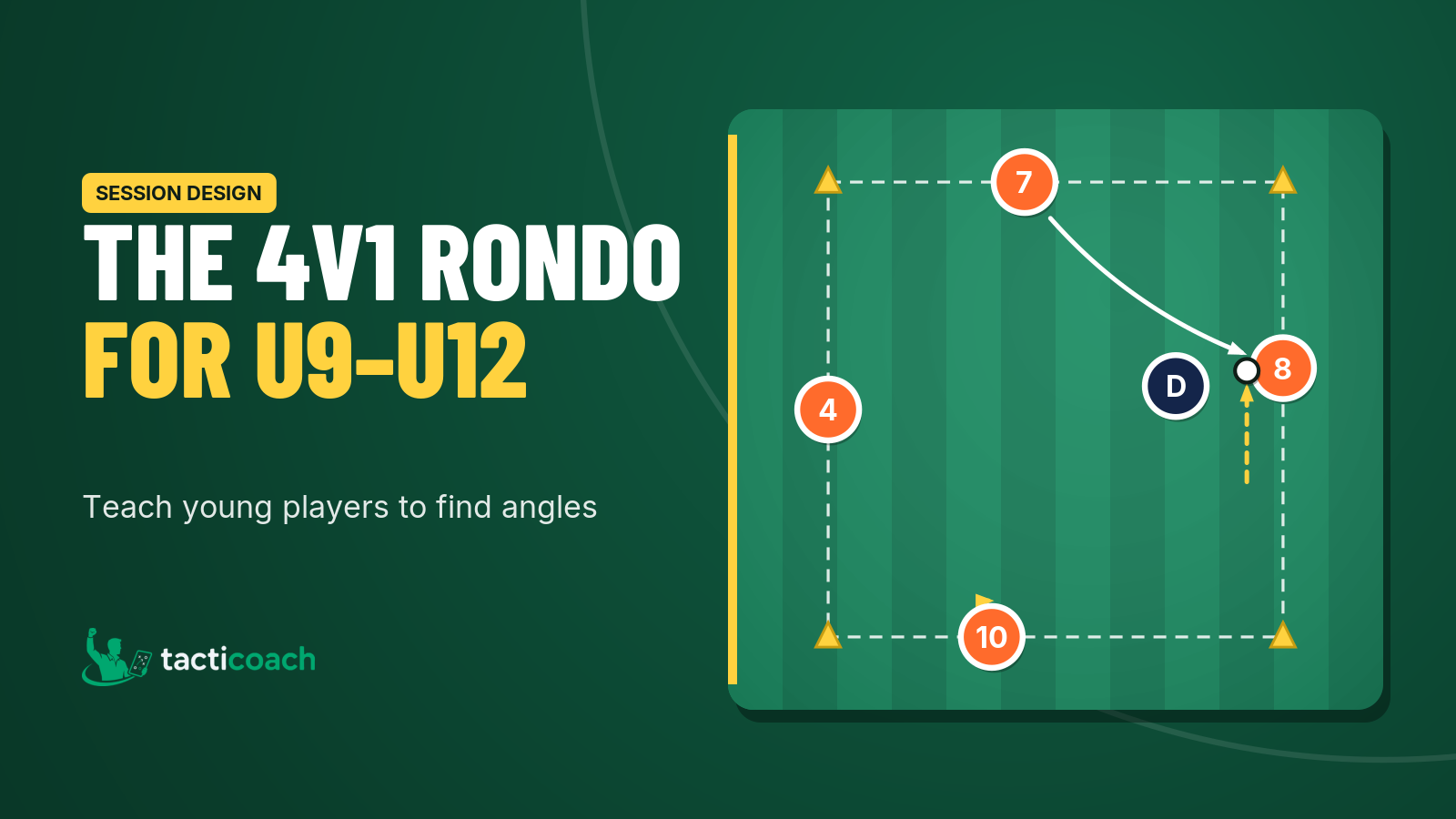
Small-sided games pair naturally with the 4v1 rondo as a warm-up and fit straight into the structure in our 60-minute session plan.
Put this into practice tonight
The board, the drill sheet and a 4K video for the parents' group — all from one practice. Opening to coaches soon.