The practice
Facts for planning — adapt them to your group.- Players
- 12 incl. 2 GKs
- Area
- half a pitch
- Time
- 60 min
Equipment: 14 balls, about 24 cones, 2 bib colours, 2 goals + 4 small goals
Most grassroots coaches plan their session in the car on the way to training. That's fine, until three extra players turn up, it starts raining, and the drill you found online needs 16 cones you don't have. A good plan doesn't have to take long. It just needs the right shape and a plan B for the numbers.
This guide gives you a simple six-step way to plan any session, then a full 60-minute example for a U10–U11 group, with timings, numbers and equipment that add up.
The shape of a good session
Most modern coach education, from FIFA's grassroots material to national associations around the world, follows the same idea: play, practise, play. Players arrive and play, you work on one thing in a practice, and then they play again so they can use it in a game.
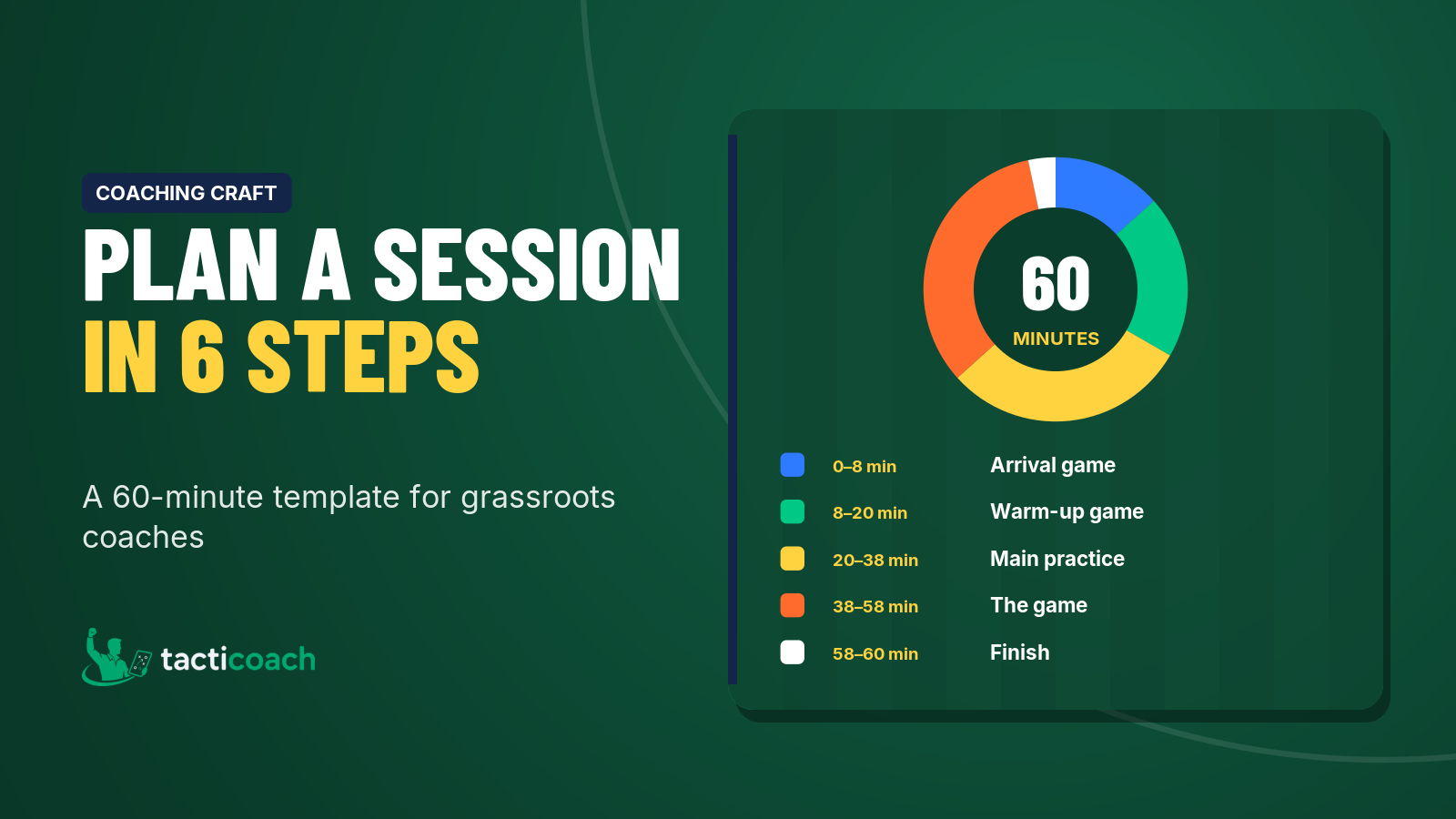
A practical version for a 60-minute session:
- Arrival game (5–10 min): something players can join as they turn up. No waiting around.
- Warm-up game (10–15 min): ball-based, linked to the theme. Nobody needs to run laps.
- Main practice (15–20 min): the theme in a focused practice, progressed once.
- The game (20–25 min): the longest part of the session, with a condition that rewards the theme.
- Finish (2–5 min): two questions, one thing to remember.
Six steps to plan any session
1. Pick one theme
Choose one thing, ideally from the last match: "we kept receiving with our backs to goal" becomes receiving to play forward. One theme, and a session can do it properly.
2. Count players and measure space
Write down how many players you expect, how many goalkeepers and how much space you have. Every practice has to work with those numbers, not the ones in the drill you copied.
3. Fit the theme into play, practise, play
Pick an arrival game, a warm-up game, one practice and one game that all link to the theme. Our 4v1 rondo and the six small-sided games are good building blocks.
4. Write two or three coaching points
Not ten. Two or three short points you'll actually say, for example "open up before you receive" and "first touch forward".
5. Plan B for numbers and weather
Decide in advance what happens if you have four more or four fewer players than expected, and what you'll do if half the pitch is waterlogged.
6. Review it afterwards
Two minutes after training: what worked, what didn't, and what you'll carry into next week. Write it down, because you won't remember by Saturday.
A full 60-minute example: U10–U11, receiving to play forward
Group: 12 players including 2 goalkeepers, playing 7v7 in matches. Space: about half a full-size pitch.
0–8 min · Arrival game
3v3 on small pitches (20 × 15 m, two small goals). Players join a game as they arrive. No coaching, just play.
8–20 min · Warm-up: gates game
All 12 players in a 30 × 25 m area with 6 cone gates. Players work in pairs with a ball. One partner passes through a gate, and the other receives on the half-turn and dribbles on to a new gate. Swap roles every minute. Keepers join in, then do 3 minutes of handling with each other at the end.
20–38 min · Main practice: directional rondo
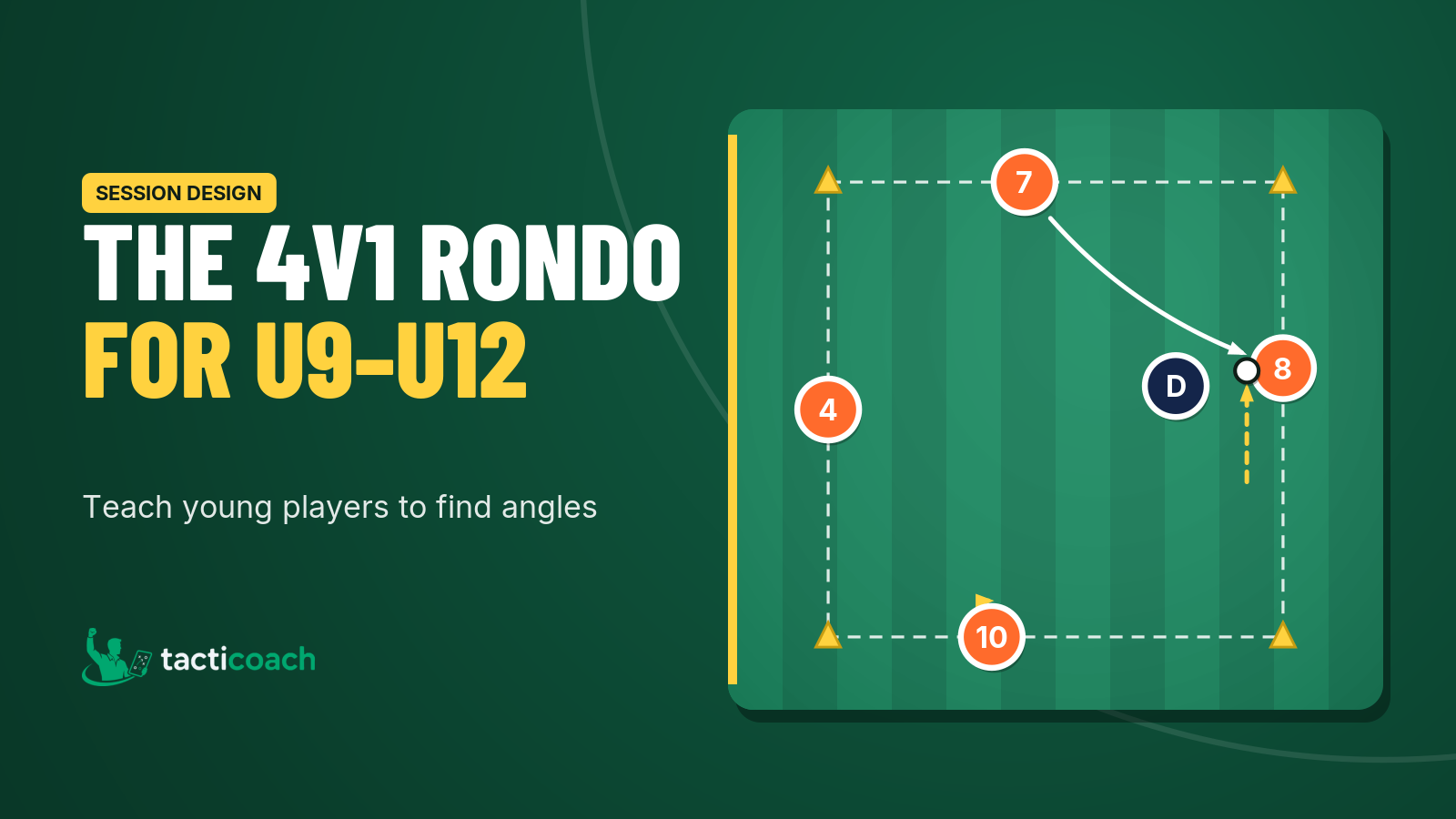
Two areas of 12 × 18 m, with five outfield players per area: a 4v1 where the four score by passing to a team-mate who has moved to the far end of the area. Then the move starts again from that end.
- Coaching points: open your body before the ball arrives, and take your first touch forward when the space is in front of you.
- Progression after 9 minutes: make it a 3v2 (one attacker joins the defender), so finding the free player gets harder.
- Meanwhile: keepers work in goal on the game pitch, receiving back-passes and playing out, so they're warm for the game.
38–58 min · The game: 5v5 + goalkeepers
On a pitch of about 40 × 30 m. Condition: a goal counts double if the scorer's team got the ball into the opposition half with a player receiving on the half-turn. Play 2 × 9 minutes with a short drink break, and coach on the move.
58–60 min · Finish
Ask two questions: "When did you get to face forward today?" and "What helped you do it?" Then send them home with one sentence to remember.
Kit check
- 12 balls (one each) plus 2 spares
- About 24 cones (gates, two rondo areas, game pitch)
- Bibs: 6 of one colour and 6 of another. The rondo uses the same bibs: 1 per area, then 2 after the progression.
- 2 goals for the game, 4 small goals for the arrival games
- Water and a first-aid kit
When the numbers change (they will)
Counts are outfield players, plus your two keepers:
- 6 outfield: one rondo area (4v1, with the sixth player swapping in each round); game 3v3 + keepers.
- 8 outfield: two rondo areas of 3v1; game 4v4 + keepers.
- 12 outfield: two areas of 4v2; game 6v6 + keepers, which is your 7v7 match format.
- 14 outfield: three rondo areas (5, 5 and 4 players); game 6v6 + keepers with two players rotating on every 4 minutes.
Every player should be playing or about to play. If anyone waits more than a minute, change the set-up.
Make it quicker next time
The first plan takes the longest. After that, you reuse and adapt. Save your sessions somewhere you can find them, keep each practice as a drawing with its numbers and coaching points, and build a season from the themes your matches show you. A session you can open on your phone at the side of the pitch is worth more than a perfect plan left at home.
Put this into practice tonight
The board, the drill sheet and a 4K video for the parents' group — all from one practice. Opening to coaches soon.